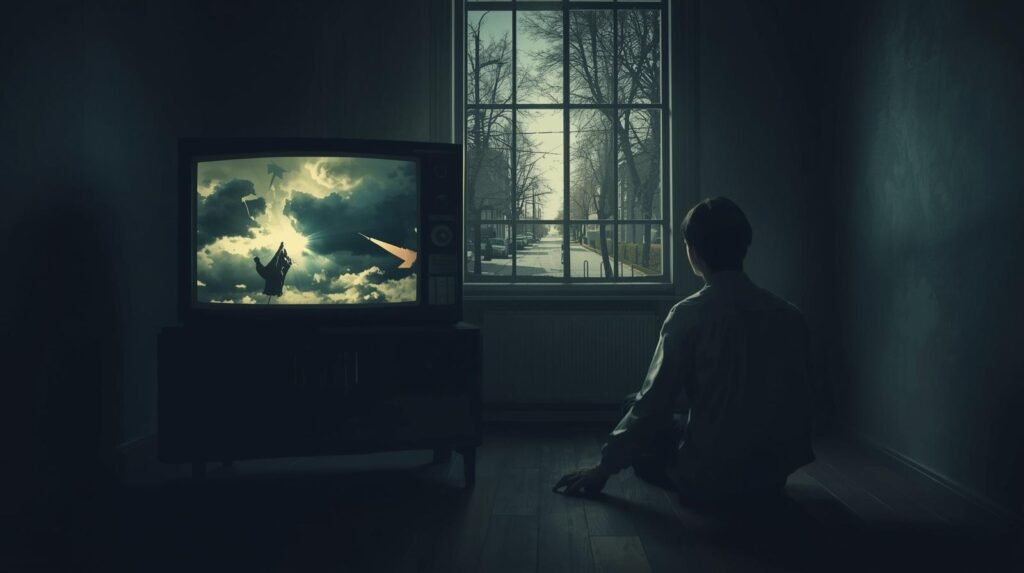
It was probably 2001 or 2002. I returned home from work and as I was climbing the stairs, I saw four or five women, neighbours, sitting on the steps as they very often did in India back then, long before smartphones, WhatsApp or Facebook. Usually they’d be chatting about their families, food, whatever came up, and would greet me every time I passed. But not that day.
I sensed something was wrong but avoided asking. While going up the stairs though, I overheard something about someone dying, someone named Mihir.
I went inside and asked my mom why she wasn’t at the neighbour gathering. She brushed off my question with an “ehhh.” I told her it seemed like someone had died, that the group looked genuinely sad.
My mom smiled at me. What an evil woman, I thought. Smiling at someone’s death. But then she told me that yes, Mihir had died, except he wasn’t a real person. He was the lead male character in a popular TV series, and in the previous episode the writers had killed him off.
The next day, newspapers ran full page reports on a wave of national grief across India, with huge protests demanding the character be brought back. I am not making this up. Anyone who was an adult in India in 2001 or 2002 will confirm it.
I was at my lowest point in those days, utterly lost and depressed. And yet I found myself thinking, good lord, why would anyone take imaginary stories this seriously? I could understand crying while watching something moving. But carrying it into the next day, making public protests over it?
To suffer over something that isn’t real at all, is that not the worst possible use of our imagination?
Estimation vs Imagination
I want to draw a distinction between two things that often get confused.
Estimation and imagination.
To estimate is to use the information you have, apply what you’ve learned, and calculate a reasonable trajectory. You look at a file on your desk and think, this will take three days. That’s an estimate. It might be slightly off, but it’s grounded in something calculable.
Imagination is different. Wild, untethered imagination. Your boss gives you a file and you see immediately that you can’t finish it in time. Then the mind takes over. You picture the angry boss pointing at you. You hear him shouting in front of your coworkers. You see yourself fired. You start calculating how quickly you can find another job before the next loan instalment is due. Anxiety moves in. Panic follows.
You must have your own stories like this. Moments when you were genuinely suffering over something that later turned out to be nothing but wild imagination.
Our minds are wired to envision possible outcomes of every situation. That is genuinely useful. It prepares us for what might be coming.
But the question worth asking is what is guiding those visions. Estimation, or wild imagination?
A great deal of our suffering is unnecessary because we are grieving our own versions of Mihir, situations that exist only in the mind. If we could stop that unnecessary use of imagination, many of our emotional reactions simply wouldn’t happen in the first place.
Emotional reactions don’t fire because something is real. They fire because something is perceived to be real.
Imagination, and our own belief in it, keeps us living inside a personal TV series. The body doesn’t check whether what’s playing on its inner screen is real or not. It responds to the broadcast regardless.
Working With the Inner Screen
The practice here is simple, though not always easy.
As this arises in daily life, watch the inner screen.
- Notice what kind of story is running. Not to judge it or push it away, just to see it.
- Ask yourself whether the story your mind is telling you is a well-informed estimate or wild imagination. How likely is it that the scenario playing out in your mind will actually come to pass?
- A small crack in your conviction that something is real is all it takes to break the intensity of the reaction. You don’t need to dismantle the whole story. Just enough doubt to loosen its grip.
Start tracking how often your mind reaches for estimation versus imagination when it tries to predict what’s coming.